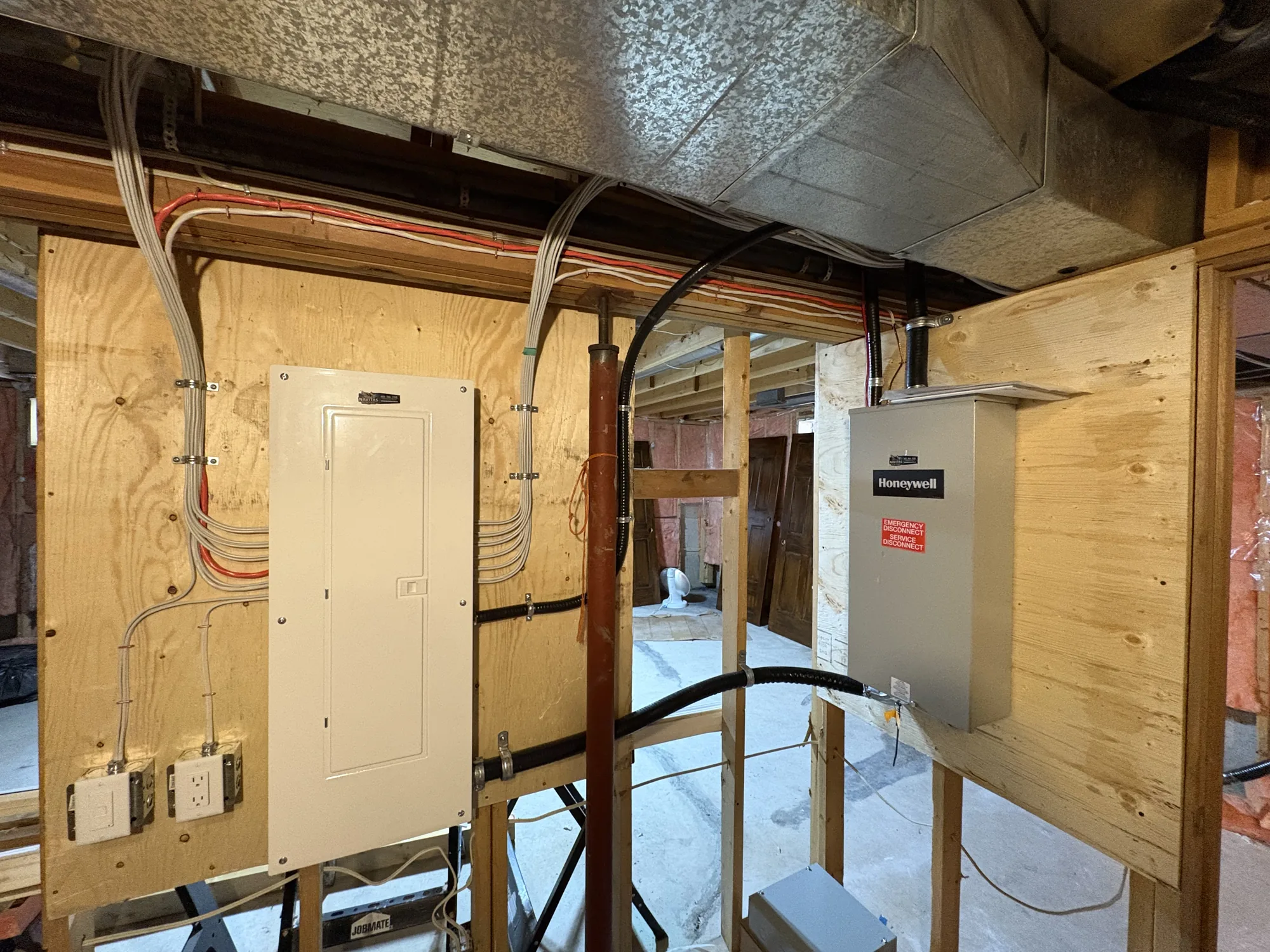
If you bought an Alberta house built between roughly 1970 and 1990, there's a real chance the grey panel in your basement or utility room says "Federal Pioneer" on it. Most days, it's quietly doing its job. The problem is the days it doesn't. This is a short, plain-language look at why electricians like us recommend replacement when we find one, and what the swap actually costs and involves.
What's the Issue?
Federal Pioneer panels (and a closely related US brand, Federal Pacific) have a documented issue: the breakers don't always trip the way they're supposed to under a fault. A breaker is the device that protects the wires behind your walls. If those wires draw more current than they should (a short circuit, a damaged appliance, a melted insulation point), the breaker is meant to snap open and cut power instantly. When it doesn't, the wires can keep heating up until something catches fire.
It's not "every Federal Pioneer panel will fail." It's "a higher-than-acceptable percentage of these breakers fail to trip in standard testing." That's enough of a known risk that insurance carriers, building inspectors and electricians treat them as a recommended replacement when they're found in occupied homes.
Which Homes Have Them?
- Build era: Mostly 1970s and 1980s, with some installations into the early 90s. If your home was built later, you almost certainly have a different brand.
- Look: Greyish metal door, "Federal Pioneer" or "Stab-Lok" label on the inside of the door. Breakers are typically red, black or grey toggles.
- Service size: Frequently 100 A. The same era's panels at higher service sizes are usually different brands.
- Sub-panels: The brand also made sub-panels for garages and additions. If your main panel is something else but you have a Federal Pioneer sub-panel feeding a workshop or hot tub, the same recommendation applies.
Got a Federal Pioneer Panel?
Free site visit, fixed quote, full-day swap in most cases. Call Navitas Electric on (403) 466-2338.
Call for a Free QuoteWhat Insurance Carriers Are Doing
Over the last decade, more Alberta home insurance providers have begun flagging Federal Pioneer panels on policy renewals. The most common outcomes:
- Premium increase: Sometimes a modest annual surcharge to reflect the perceived risk.
- Coverage exclusion: Some carriers will refuse to cover fire damage that originates at the panel.
- Renewal denied: A small number of carriers will refuse to renew unless the panel is replaced within a specified window.
- Buyer pressure: If you're selling, a home inspector flagging a Federal Pioneer panel often becomes a price negotiation point or a closing condition.
None of this is guaranteed at every carrier, but it's enough of a trend that doing the math on replacement makes sense.
Replacement Cost and Process
Most residential Federal Pioneer panel replacements in our area land between $2,500 and $6,000. The wide range covers everything from a like-for-like 100 A swap to a full upgrade to 200 A with a new meter base and masthead work.
- Free site visit: We assess the panel, the service feed, the meter base and the masthead. You get a fixed written quote.
- Permit and utility coordination: We pull the electrical permit and coordinate the disconnect with FortisAlberta, ATCO or ENMAX depending on your area.
- Swap day: Power is off for a few hours while we replace the panel. Breakers transfer to the new panel in the same logical order so your labels still make sense.
- Inspection: The safety codes inspector visits within the week. We attend and handle it.
- Done: You have a modern panel, room to grow, and one less thing on the worry list.
Side Benefits of the Upgrade
- EV-ready capacity: A 200 A service comfortably supports a Level 2 charger plus normal household load. You don't have to plan around it.
- Heat pump headroom: Modern cold-climate heat pumps are large electrical loads. A 200 A service takes one in stride.
- Solar-ready: Net-metered solar systems tie into the panel. Newer panels make that tie-in cleaner.
- AFCI / GFCI compliance: Modern breakers offer arc-fault and ground-fault protection on the circuits where the current code requires it.
- Resale value: A panel upgrade is one of the few electrical investments that meaningfully shows up in appraisal and inspection reports.
Frequently Asked Questions
Maybe. Many policies are written without a panel inspection. The information often surfaces on a renewal year that includes an updated home inspection or when you file a claim. If it concerns you, the simplest thing is to ask your carrier directly what their policy on Federal Pioneer panels is for your renewal.
No. Power is typically off for three to five hours while we swap the panel. We start in the morning and you're back up by evening. The utility coordinates the disconnect window with us in advance so the day is predictable.
Yes. A like-for-like 100 A panel replacement is the cheapest option and is appropriate for many homes. We'll tell you on the site visit whether the load calc suggests you'd benefit from going to 200 A while we have the panel out, or whether 100 A is genuinely fine.
Yes. We pull the permit, book the utility disconnect, do the swap, and attend the safety codes inspection. You deal with us, not three separate parties.
Not for the panel swap itself, but if you're upgrading the service as part of preparing for solar, a heat pump or EV charging, those downstream installs may qualify for federal or provincial incentives. We'll talk you through what applies on the site visit.